


English
Request a Quote




In recent years, exosomes have become one of the fastest-growing research areas in the life sciences. In fields such as regenerative medicine, cell therapy, and disease diagnosis, these extracellular vesicles (30–150 nm) are increasingly viewed as potential natural delivery carriers.
Exosomes are released into the extracellular space through the fusion of multivesicular bodies (MVBs) with the cell membrane. They can carry a range of bioactive molecules, including proteins, microRNA, and mRNA, and play an important role in intercellular communication. With ongoing research, exosomes are being explored for applications such as:
• Tissue repair
• Immune modulation
• Drug delivery
Some stem cell-derived exosome products have entered clinical studies, such as ExoFlo™. However, as the field moves toward industrialization, a key challenge emerges: the ability to isolate exosomes in the laboratory does not guarantee scalable manufacturing.
The difficulty of exosome purification primarily arises from their unique physical properties.
Exosomes typically range from 30 to 150 nm in diameter, overlapping significantly with various biological particles, such as:
• Lipoprotein particles
• Viral particles
• Other extracellular vesicles
In cell culture supernatants, these particles often coexist with exosomes and are highly similar in size, density, and even surface properties, making it difficult to achieve high purity using a single separation method.
At the same time, exosomes are nanoscale vesicles enclosed by a lipid bilayer and are sensitive to shear force, osmotic pressure, and pH changes. Harsh processing conditions can easily lead to vesicle disruption or structural damage.
Therefore, exosome purification processes must meet two key requirements: sufficient separation capability and mild, well-controlled operating conditions.
In the early stages of exosome research, ultracentrifugation was the most commonly used separation method. By gradually increasing centrifugal force, particles of different sizes can be sequentially sedimented, enabling exosome enrichment. While widely used in laboratory settings, this approach shows clear limitations in industrial production:
• Limited scalability: Centrifugation systems have restricted processing volumes, making them unsuitable for large-scale manufacturing.
• Reproducibility issues: Separation efficiency is highly dependent on equipment and operating conditions, making process standardization and scale-up challenging.
• Low efficiency: A complete centrifugation workflow can be time-consuming with limited throughput.
As a result, when exosome production moves toward industrialization, the process strategy begins to shift.
As the exosome industry continues to mature, a more engineering-oriented purification workflow has gradually emerged:
Clarification → TFF concentration → Chromatographic purification
In this workflow:
• Filtration steps address volume reduction and concentration
• Chromatography steps determine the final product purity
Filtration technologies such as tangential flow filtration (TFF) can efficiently concentrate exosomes. However, since their separation mechanism mainly relies on particle size differences, their ability to distinguish impurities with similar sizes remains limited.
As a result, the chromatographic separation step often becomes the key determinant of final product purity.
Currently, the most widely used chromatographic method for exosome purification is size exclusion chromatography (SEC).
The separation mechanism of SEC is based on differences in particle size. When a sample passes through porous chromatography media:
• Small proteins can enter the pores of the media
• Larger particles are unable to enter the pores
Because exosomes are relatively large particles, they are typically eluted first, while proteins and small molecular impurities in the culture medium are retained longer and elute later.
Compared with centrifugation-based methods, SEC offers several distinct advantages:
• Mild separation conditions
• Minimal impact on exosome integrity
• Good reproducibility
• Easy scalability for manufacturing
As a result, SEC is increasingly becoming a core purification step in exosome production processes.
Beyond size differences, exosomes also exhibit distinct surface charge properties.
Exosome membranes are rich in phospholipids and glycoproteins, which typically give them a net negative charge under physiological conditions. This characteristic provides an alternative strategy for exosome purification: anion exchange chromatography (AEX).
Under suitable pH and ionic strength conditions, exosomes can bind to positively charged anion exchange media, while certain protein impurities may remain unbound or elute under different conditions.
By applying gradient elution or adjusting salt concentration, further separation between exosomes and impurities can be achieved.
In some process designs, AEX can serve either as a pre-SEC capture step or as a post-SEC polishing step to enhance overall purification efficiency.
In recent years, researchers have also been exploring mixed-mode chromatography (MMC) for exosome purification.
Mixed-mode media typically combine multiple separation mechanisms, including:
• Size exclusion effects
• Hydrophobic interactions
• Weak ionic interactions
The advantages of mixed-mode media include:
• Enhanced separation selectivity
• Better adaptability to complex feed streams
• The potential to reduce process steps
As a result, mixed-mode chromatography is increasingly being viewed as a promising approach for emerging exosome purification processes.
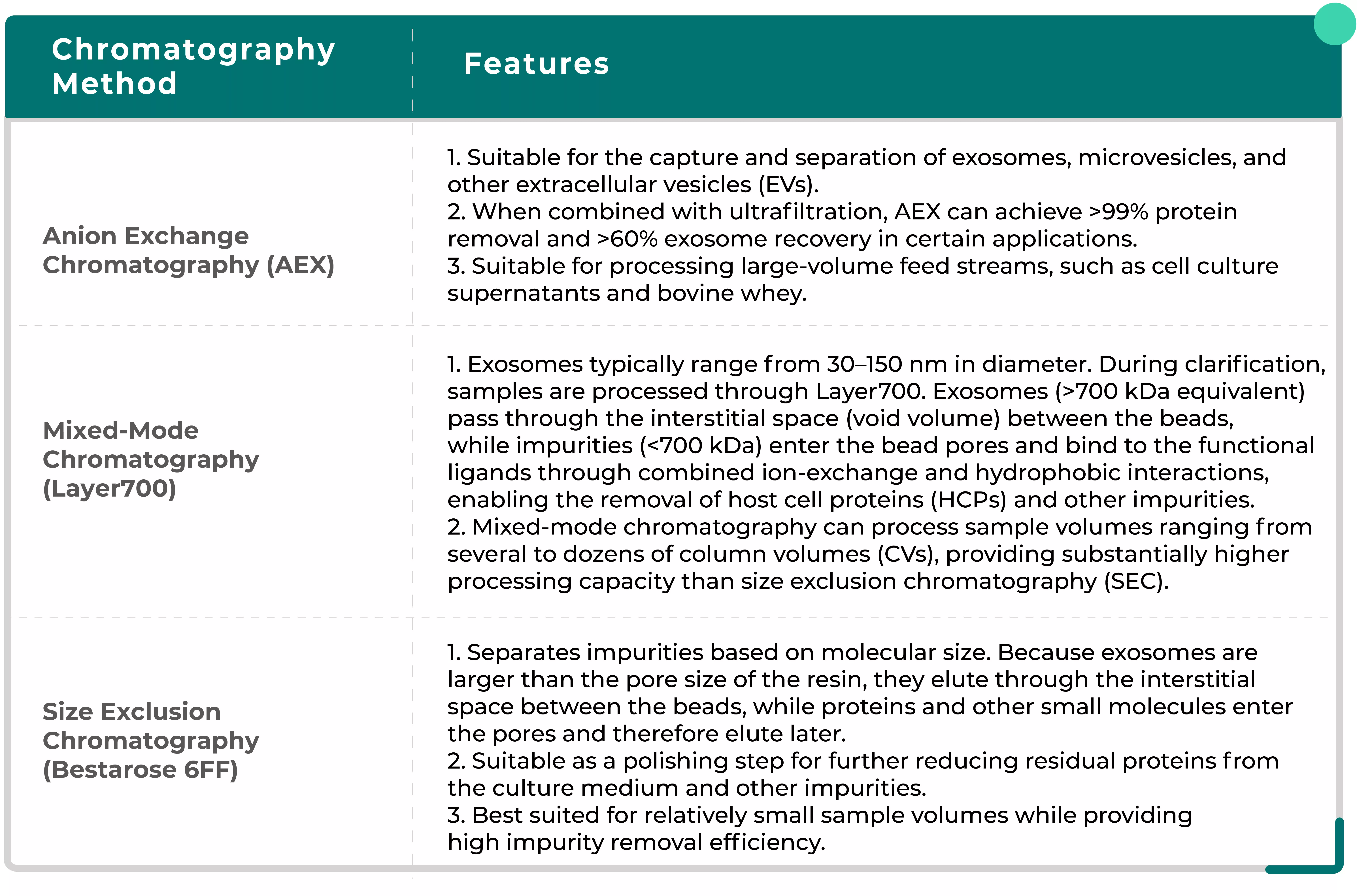
From studies of intercellular communication to the development of potential drug delivery platforms, exosomes are emerging as an important area of exploration in the life sciences. As the field continues to move toward industrialization, the importance of efficient separation and purification technologies is becoming increasingly evident.
In this context, chromatography is playing an increasingly critical role in exosome purification workflows, owing to its mild operating conditions, high resolution, and scalability.



Oct
15

Sep
24

Sep
11
.png)




.png)
.png)
.png)

.png)