


English
Request a Quote




In bioprocess development and large-scale manufacturing, few sounds are more frustrating to process engineers than a chromatography system pressure alarm. When column pressure or differential pressure (ΔP) begins to rise, the first reaction is often: “The column is clogged!” This is usually followed by the standard CIP (cleaning-in-place) sequence: flushing with a strong alkaline solution, followed by an acidic solution, or even reversing the flow direction. However, in some cases, the pressure remains unchanged even after several cleaning cycles. At this point, it is worth taking a step back and asking: Is a rise in column pressure always caused by clogging?
In this article, we look beyond the conventional assumption of clogging and examine the various causes of elevated column pressure from the perspectives of fluid mechanics and system engineering.
To understand pressure behavior, we must first consider the principles governing chromatographic flow. Darcy’s Law describes fluid flow through porous media and provides a fundamental basis for understanding the relationships among chromatography column pressure, flow velocity, and resin structure.
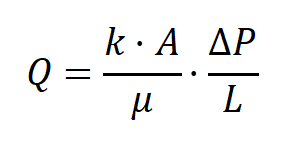
Darcy’s Law was originally developed to describe the flow of water through a sand bed. Its basic form is:
For engineering applications, it is more commonly written as:
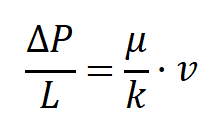
The parameters in the equation are defined as follows:
Q: volumetric flow rate
A: column cross-sectional area
v: linear velocity (= Q/A)
ΔP: pressure drop across the column
L: bed height
μ: fluid viscosity
k: permeability, which is related to resin properties such as particle size and packed-bed porosity
As the equation shows, an increase in pressure does not necessarily mean that k has decreased due to clogging. Changes in viscosity, flow velocity, and even temperature can all be reflected in the pressure reading.
Fluid viscosity (μ) is directly proportional to pressure. In biopharmaceutical processing, the following situations are often mistaken for clogging:
• Low-temperature operation: Operating pressure in a cold room at 4°C can be significantly higher than at room temperature (25°C), as water becomes more viscous at lower temperatures. The viscosity of pure water at 4°C is approximately 1.57 mPa·s, about 1.76 times that at 25°C (approximately 0.89 mPa·s). At the same flow rate and under identical tubing and column conditions, pressure increases in proportion to viscosity. Therefore, if the system pressure is 2 bar at 25°C, it may rise to approximately 3.5 bar when 4°C water is used.
• High-concentration components: Samples containing high concentrations of proteins, glycerol, or polyethylene glycol (PEG) can have substantially higher viscosity.
• Buffer transitions: Switching from water to a high-salt buffer or an organic-containing solution, such as a 20% ethanol storage solution, can cause a temporary pressure spike due to the sudden change in viscosity. At 25°C, 20% ethanol has a viscosity of approximately 1.82 mPa·s, compared with approximately 0.89 mPa·s for water—about twice as high.
Sometimes, elevated pressure has nothing to do with the column.
• Flow-path restrictions: Run the system with the column disconnected. If the pressure remains high, the problem may lie in the in-line filter, check valve, tubing fittings, or gaskets.
• Air entering the system: Air trapped in the pump head can cause flow-rate fluctuations, while bubbles trapped in the system filter can also lead to abnormal pressure readings.
Resin beads are not rigid like stones. At high flow velocities, hydrodynamic forces compress the packed bed in the direction of flow. If the resin lacks sufficient mechanical strength or the compression factor used during column packing is too high, the beads may undergo elastic deformation.
• Result: Interparticle porosity decreases, permeability (k) declines, and pressure rises nonlinearly. This is known as the “soft-bead effect.” Cleaning will not resolve the issue; the flow velocity must be reduced.
Prolonged use, repeated packing and unpacking, or excessive mechanical shear may cause resin beads to break. The resulting small fragments, known as Fines, can migrate with the liquid flow and accumulate on the bottom bed support. These particles are not contaminants introduced by the sample, but rather a sign of resin aging or physical damage.
Some polymer-based resins undergo slight changes in volume under different solution conditions, such as when switching from pure water to a high-salt solution or from a high-salt solution to an organic solvent. If the resin swells after column packing, interparticle porosity may decrease sharply, causing a rapid increase in pressure.
The most common cause is still the accumulation of target molecules and/or impurities:
• Inadequate sample pretreatment: Insufficient centrifugation or filtration allows insoluble particles to accumulate at the top of the packed bed.
• Protein precipitation: Proteins may precipitate under certain buffer conditions, such as when the pH is close to their isoelectric point.
• Non-specific binding: Lipids, pigments, or host cell proteins (HCPs) may bind strongly to the resin surface and within its pores through hydrophobic interactions.
When pressure increases, follow the steps below:
Disconnect the column and observe the system pressure.
• If the system pressure remains high: Check the in-line filter, tubing, and pump head.
• If the system pressure is normal: Proceed to troubleshoot the column.
Reduce the flow rate to a very low level and observe whether the pressure decreases linearly with the flow rate.
• If the pressure decreases linearly: Consider high fluid viscosity or an excessive flow rate.
• If the pressure remains high: Consider a physical blockage.
Determine whether the blockage is at the top of the packed bed or at the bottom bed support.
Most physical blockages occur at the top of the packed bed. Try flushing the column in the reverse direction or removing the top layer of resin for inspection.
Select a targeted cleaning method based on the nature of the contaminants.
Once physical inspection confirms deposits or binding at the top of the packed bed, using a highly concentrated alkaline solution without first identifying the cause may not always be the best approach. The CIP procedure should be tailored to the impurity profile of the sample.
• Protein deposits: From hydrolysis to denaturation
Protein precipitation and clogging caused by non-specific binding are among the most common forms of fouling at the top of the packed bed.
○ Standard approach (hydrolysis): 0.5–1.0 M NaOH solution is commonly used in industrial applications. Strong alkaline solutions can hydrolyze and solubilize most protein deposits.
○ Advanced approach (strong denaturation): If alkaline cleaning does not significantly reduce the pressure, highly hydrophobic or cross-linked protein aggregates may be present. In such cases, 6 M guanidine hydrochloride or 8 M urea may be used. These strong denaturants disrupt hydrogen bonds and hydrophobic interactions, helping to unfold and solubilize aggregated proteins.
• Lipids and hydrophobic impurities: Removing water-insoluble fouling
In expression systems based on yeast, insect cells, or plants, lipids and lipoproteins can be hidden contributors to elevated pressure. Because these impurities are poorly soluble in water, alkaline cleaning alone may have only a limited effect.
○ Organic solvent cleaning: Use 20%–30% isopropanol or ethanol. Organic solvents can weaken hydrophobic interactions and dissolve lipid residues bound to the resin surface. When using organic solvents, the pressure limits of the system must be considered because the viscosity may increase sharply when the organic solvent mixes with water.
○ Surfactant cleaning: Use 0.1%–1% nonionic surfactant, such as Triton X-100 or Tween 80. These surfactants can remove lipid residues in a manner similar to detergents and generally have a relatively limited impact on resin ligands.
• Nucleic acids and endotoxins: Removing “molecular glue”
High concentrations of host-cell DNA can act as a major binding material and contribute to elevated pressure at the top of the packed bed, particularly during the capture step.
○ Chemical degradation: A strong alkaline solution, such as 1.0 M NaOH, can degrade nucleic acids by hydrolyzing their phosphodiester bonds.
○ Enzymatic treatment: If permitted by the process, pretreating the sample with a nuclease before chromatography can help prevent this type of pressure increase at its source. Nucleases degrade DNA or RNA by cleaving the phosphodiester bonds in the nucleic acid backbone.
• Inorganic salts and metal ions: Preventing crystal formation
In certain buffer systems, inorganic salts may precipitate. One example is the exposure of phosphate-containing buffers to high concentrations of ethanol.
○ Acid cleaning: Use 0.1–0.5 M acetic acid or citric acid. Acidic conditions can effectively dissolve deposits such as calcium carbonate and metal hydroxides.
○ Chelating agent cleaning: For contamination by metal ions, such as leached nickel ions or metal ions introduced with the sample, cleaning with 50 mM EDTA can help prevent resin discoloration and abnormal pressure.
• Cleaning sequence: Follow a stepwise approach, starting with readily removable contaminants and using alkaline cleaning before organic solvents. Remove most protein deposits with an alkaline solution first, followed by an organic solvent to remove residual lipids. This helps prevent organic solvents from further denaturing and fixing protein deposits.
• Compatibility assessment: Before using any new cleaning agent, verify its chemical compatibility with the resin matrix, ligand, and chromatography system. For example, some resins are not compatible with strong acids, while certain gaskets cannot tolerate high concentrations of organic solvents.
• Contact time: Pressure recovery depends not only on flow rate but also on how long the cleaning agent remains in contact with the packed bed. A CIP recirculation time of at least 30 minutes is generally recommended.
Changes in pressure readings are the chromatography system’s way of communicating with process engineers.
An increase in column pressure does not necessarily indicate clogging. It reflects the combined effects of flow rate, fluid viscosity, resin condition, and physical resistance. Indiscriminate cleaning not only wastes time but may also damage ligand activity.
By understanding Darcy’s Law and the physical principles behind pressure changes, process engineers can diagnose problems more accurately during complex and variable process development.



Oct
15


Sep
24

Sep
11
.png)




.png)
.png)
.png)

.png)