


English
Request a Quote




In downstream process development screening studies, ion exchange chromatography (IEX) is almost always a “must-have” option for purification engineers. However, when selecting between SP (strong cation exchanger) and CM (weak cation exchanger), or Q (strong anion exchanger) and DEAE (weak anion exchanger), the decision-making logic often remains focused on conventional assumptions:
• “Strong ion exchangers provide stable binding and a broader operating pH range.”
• “The binding capacity of weak ion exchangers may be more sensitive to pH fluctuations and they are usually considered an alternative to strong ion exchangers.”
There is also a common misconception that the terms “strong” and “weak” represent the absolute binding strength between the resin and proteins.
However, the most fundamental—and often overlooked—difference between strong and weak ion exchange resins actually lies in their selectivity.
Today, we will explore the “charge interplay” behind strong and weak ion exchange, and uncover the underlying principles that determine their separation performance.
First, it is important to clarify a fundamental concept: the classification of strong and weak ion exchange resins refers to the ionization ability of their functional groups (pKa), rather than the absolute binding strength between the resin and proteins.
• Strong cation exchangers (SCX): such as sulfopropyl (SP), with a pKa < 1.
• Strong anion exchangers (SAX): such as quaternary ammonium (Q), with a pKa > 13.
• Characteristics: Within the commonly used pH range for protein purification (pH 2–12), these resins remain fully ionized, maintaining a constant charge density that is independent of the solution pH.
• Weak cation exchangers (WCX): such as carboxymethyl (CM), with a pKa ≈ 4.5.
• Weak anion exchangers (WAX): such as diethylaminoethyl (DEAE), with a pKa ≈ 9.5.
• Characteristics: The charge density of weak ion exchangers is highly dependent on pH. When the buffer pH approaches the pKa of the functional group, protonation or deprotonation occurs, gradually reducing or even eliminating the effective surface charge (negative charge for WCX or positive charge for WAX).
Why can weak ion exchange resins often achieve higher resolution than strong ion exchange resins when separating charge variants? Taking cation exchange chromatography as an example, we can explore the underlying mechanism:
• The logic of SCX (single-dimensional titration):
Because the charge density on the surface of strong cation exchangers remains constant, when pH is adjusted for elution, only the charge distribution on the protein surface changes. This represents a one-way interaction between a “changing protein” and a “static resin”.
• The logic of WCX (dual-dimensional titration):
During WCX separation, when the pH is adjusted, both the surface charge of the protein and the surface charge of the resin undergo dynamic changes simultaneously. This dual variation greatly expands the selectivity space during chromatography. For large biomolecules such as monoclonal antibodies, where subtle charge differences arise from modifications such as deamidation or C-terminal lysine clipping, WCX can amplify these differences through its own variations in charge density, thereby achieving higher resolution than SCX.
This is an extremely common misconception. In fact, under certain conditions, weak ion exchange resins may bind proteins more strongly than strong ion exchange resins.
The interaction between strong cation exchange groups, such as –SO₃⁻, and proteins is driven almost entirely by Coulombic electrostatic attraction. By contrast, weak cation exchange groups, such as –COO⁻, can potentially form hydrogen bonds and van der Waals interactions in addition to electrostatic interactions.
In practical purification studies, we often observe that, at the same sample loading pH, the target protein elutes from a WCX resin at a higher conductivity—or salt concentration—than from an SCX resin. This indicates that, beyond electrostatic selectivity, more complex molecular interactions can occur between WCX resins and proteins.
How should strong and weak ion exchangers be selected in practical process development?
• Capture:
The primary objectives at the capture stage are rapid processing and high binding capacity. SCX resins maintain a stable charge density and generally provide greater process robustness. Minor pH deviations during buffer preparation are therefore less likely to cause a substantial decrease in dynamic binding capacity (DBC).
• Polishing:
When SCX does not provide sufficient separation, WCX should be evaluated. Because both the protein charge and resin charge respond to pH, WCX offers an additional dimension of selectivity. This makes it particularly suitable for separating variants of large-molecule therapeutics, as it can respond more sensitively to subtle differences in conformation and surface charge.
• Impurity removal in flow-through mode:
SAX resins, such as Q resins, are generally preferred. In monoclonal antibody purification, Q chromatography is commonly operated in flow-through mode to remove DNA, endotoxins, and host cell proteins (HCPs). SAX resins retain a strong and stable positive charge at elevated pH, supporting efficient binding and clearance of negatively charged impurities.
• Separation of sensitive proteins in bind–elute mode:
WAX resins, such as DEAE resins, may be considered. When the target protein binds too strongly to SAX and requires a very high salt concentration for elution, the resulting conditions may compromise protein stability. Switching to WAX can moderate the binding strength and enable milder elution conditions, helping preserve protein activity.
• If the process requires protein binding at a low pH, such as below 4.5, SCX is generally the only practical option. When the pH approaches or falls below the pKa of WCX, which is approximately 4.5, a large proportion of the weak cation exchange groups become protonated. The resin then loses much of its negative charge, causing a sharp decline in protein binding capacity and poor process robustness.
• Similarly, if the protein must bind at a high pH, such as above 9.5, SAX is generally required. Under these conditions, the functional groups of WAX become extensively deprotonated and lose the effective positive charge needed to bind negatively charged proteins.
◉ Separation of β-Lactoglobulin and KatG with Diamond DEAE Mustang
• Column: EzScreen, 4.4 mL
• Buffer A: 20 mM piperazine hexahydrate, pH 6.2
• Buffer B: 20 mM piperazine hexahydrate, 0.3 M NaCl, pH 6.2
• Sample: β-Lactoglobulin, 22 mg/mL; KatG, 4 mg/mL
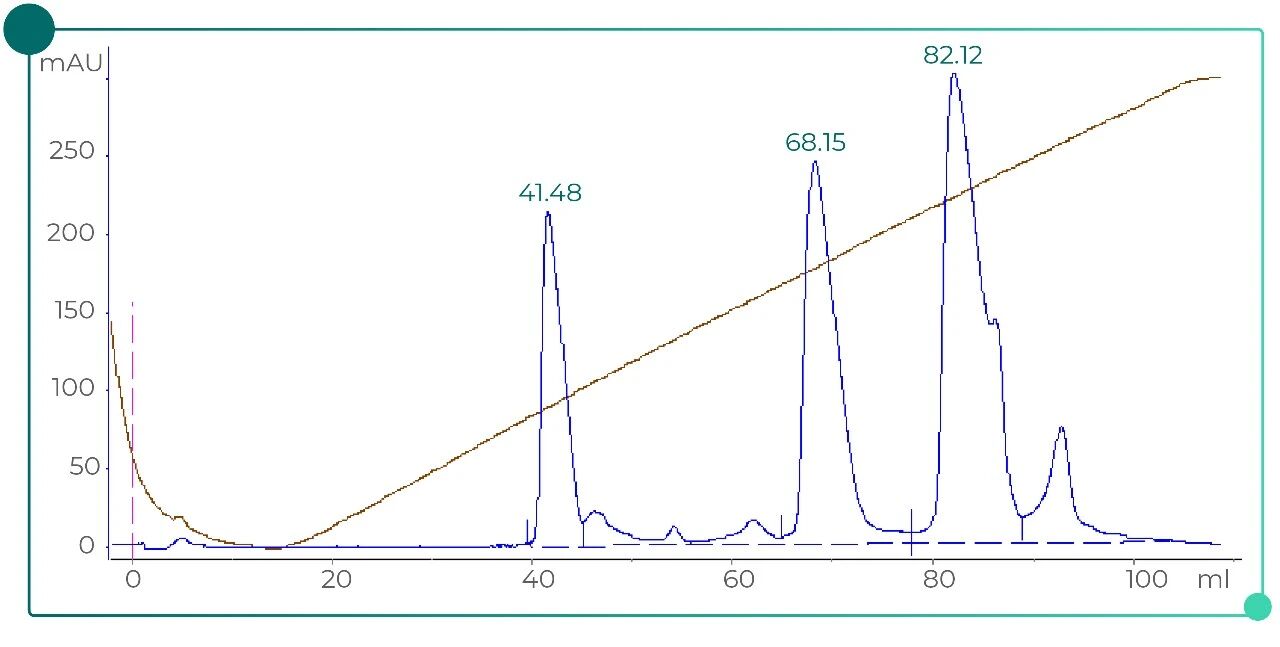
Fig. 1 Chromatogram of β-Lactoglobulin and KatG Separation with Diamond DEAE Mustang
In this study, DEAE Bestarose HP weak anion exchange chromatography was used to effectively separate β-lactoglobulin and KatG under the selected pH conditions. As shown in the chromatogram, the two proteins eluted sequentially along the salt gradient, producing distinct, baseline-resolved peaks. These results demonstrate that DEAE Bestarose HP provides good charge-based selectivity between the two proteins, enabling their efficient separation and confirming the suitability of this weak anion exchange resin for target protein separation and purification.
Strong and weak ion exchange resins are not a matter of a “primary choice” versus a “backup option.” Rather, they are two distinct tools designed for different application scenarios:
• Strong ion exchange resins (S/Q) are your “machete”: With a constant charge density, robust performance, and highly predictable behavior, they form the foundation of stable, scalable manufacturing platforms. They are particularly well suited for large-scale capture and broad removal of common impurities.
• Weak ion exchange resins (CM/DEAE) are your “scalpel”: Their charge density is dynamically adjustable, giving them unique selectivity. They are particularly valuable for tackling challenging fine separations and achieving high-resolution peak separation.
Only when you move beyond the literal meaning of “strong” and “weak” and begin using the titration effect to manipulate selectivity can you truly master the essence of ion exchange chromatography.


Nov
27

Nov
25
Nov
13





.png)
.png)
.png)

.png)